Why Paediatric Audiology Rooms Are Different
Adult audiology largely takes place with the patient seated, headphones or insert earphones in place, responding to a series of tones via a button or verbal cue. It’s a controlled, largely static process and a well-designed adult audiology booth can be relatively compact.
Paediatric audiology is a very different discipline. Depending on the child’s age, hearing assessment may involve:
- Visual reinforcement audiometry (VRA)
- Conditioned play audiometry
- Standard pure-tone audiometry
- Distraction testing and free-field speech testing
Each of these methods has implications for the physical space. A paediatric audiology room needs to accommodate the child, at least one parent or carer, the audiologist, sometimes a second clinician, test equipment positioned around the room, and room for the child to move without compromising the acoustic environment.
Space and Room Layout
The single biggest difference between an adult and a paediatric audiology room is size. Paediatric rooms need to be substantially larger to accommodate:
Free-field testing. Children who can’t or won’t wear headphones are assessed using loudspeakers positioned within the room. The room needs sufficient distance between the speakers and the child’s seated position to produce a valid free-field sound measurement, which in turn drives minimum internal dimensions.
Visual reinforcement equipment. VRA testing typically uses visual reward units positioned at set angles around the child. There needs to be enough space to position these correctly and for the child to turn toward them naturally.
Companion seating. A parent, carer, or occasionally a sibling will usually be present in the room throughout the assessment. Their seating needs to be considered from the start.
Movement and play. Young children rarely sit still. The room needs to feel like somewhere a child can be at ease, not somewhere they’re pinned to a chair for the duration of the appointment.
It is important to note that every project is different so a specialist designer will work through the actual dimensions based on the testing protocols the room needs to support and the age range it’s designed for.
Acoustic Requirements
The core acoustic requirement of a paediatric audiology room is the same as for an adult room: a controlled, low-noise environment that allows for accurate hearing assessment. The relevant standards, ISO 8253 and the British Society of Audiology’s recommended procedures, apply equally to paediatric testing.
The additional consideration is that children might be less tolerant of a highly clinical space. Acoustic treatment inside the room, the quality of the ventilation, and the design of the doors and observation windows all affect how the space feels as much as how it performs.
A well-designed paediatric room delivers the acoustic performance the assessment requires while feeling comfortable, contained, and calm.
Observation room
In paediatric assessment, the audiologist often observes the child from an adjacent control area rather than being in the room with them. This requires careful thought about:
Observation windows. These need to give the audiologist a clear view of the child’s face, body language, and responses without being visually intrusive from the child’s side. Well-detailed acoustic glazing preserves the acoustic performance of the room without compromising the sightline.
Layout of the control area. The audiologist needs to be able to see the child, operate the testing equipment, and communicate with any second clinician without disrupting the assessment.
Child-Friendly Design That Doesn’t Compromise Clinical Performance
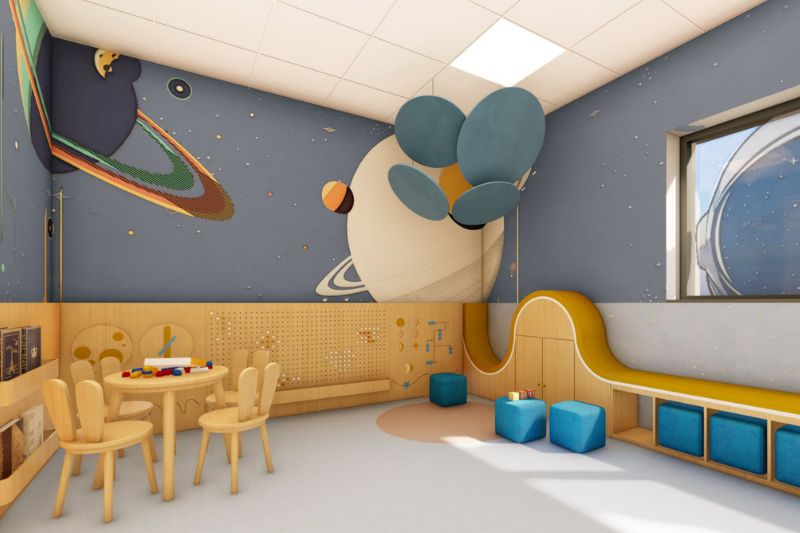
Very bright, high-contrast, or busy visual environments can be distracting. Better paediatric audiology rooms tend to use:
Warm, muted colour palettes. Soft neutrals with gentle accent colours create an environment that feels welcoming without being overstimulating.
Considered lighting. Warm, diffused lighting is more comfortable for children (and parents) than harsh clinical downlighting. Dimmable circuits allow lighting to be adjusted for different test conditions.
Subtle graphic detail. A simple mural, a gentle wall pattern, or a considered piece of art gives the child something to look at without being visually overwhelming.
Comfortable, appropriately-sized seating. Child-height seating for the patient, comfortable adult seating for the parent or carer.
Materials that feel warm, not clinical. Where possible, matte finishes, warm wood tones, and soft touch points make the room feel less like a medical environment.
The best paediatric audiology rooms feel more like a well-designed nursery consulting space than a testing chamber while still delivering full clinical performance.
Working With NHS and Private Clinic Procurement
The route to a completed paediatric audiology room varies significantly depending on who’s commissioning it.
NHS projects typically involve estates teams, capital funding cycles, clinical procurement processes, and often the involvement of the trust’s own audiology service leads. Timescales can be extended, and specification packages are often driven by procurement frameworks. Suppliers who have worked with the NHS before tend to navigate these routes more smoothly.
Private clinic projects are usually faster-moving, with the clinical lead often directly involved in decision-making. Design freedom is often greater, though the fundamental clinical requirements are the same.
In both cases, engaging a specialist supplier early gives the best outcome. Paediatric audiology rooms benefit significantly from being designed as an integrated whole rather than assembled from separate acoustic, joinery, and MEP packages.
In Summary
Paediatric audiology rooms are specialist environments that need to combine clinical acoustic performance with a design that feels safe and comfortable for children. The room needs to be large enough for the range of testing methods that paediatric assessment involves, well-considered in terms of observation and layout, acoustically compliant with the relevant standards, and designed with a genuinely child-appropriate aesthetic.
Get all of that right, and you have a room that works clinically, works for the patient, and works for the audiologist.
Planning a paediatric audiology room? Speak to QuietStar.
QuietStar designs and installs audiology rooms and booths for NHS trusts, private clinics, and educational institutions across the UK including paediatric-specific facilities designed around the clinical needs of young patients.
View our acoustic testing rooms capabilities at quietstar.co.uk/services/acoustic-testing-rooms/ or speak to our team on 0333 444 0458.
Related Services
Learn more about QuietStar’s audiology room design services and how we can support your next project.
Need help with a refurbishment? Explore our audiology room upgrades and acoustic treatment solutions.