What Both Chambers Have in Common
Both full and semi-anechoic chambers are designed to do the same fundamental thing: create a space where sound reflections are eliminated as far as possible, so that any noise produced by a test subject inside the room can be measured accurately without interference from the room itself.
Both types share the same core construction principles:
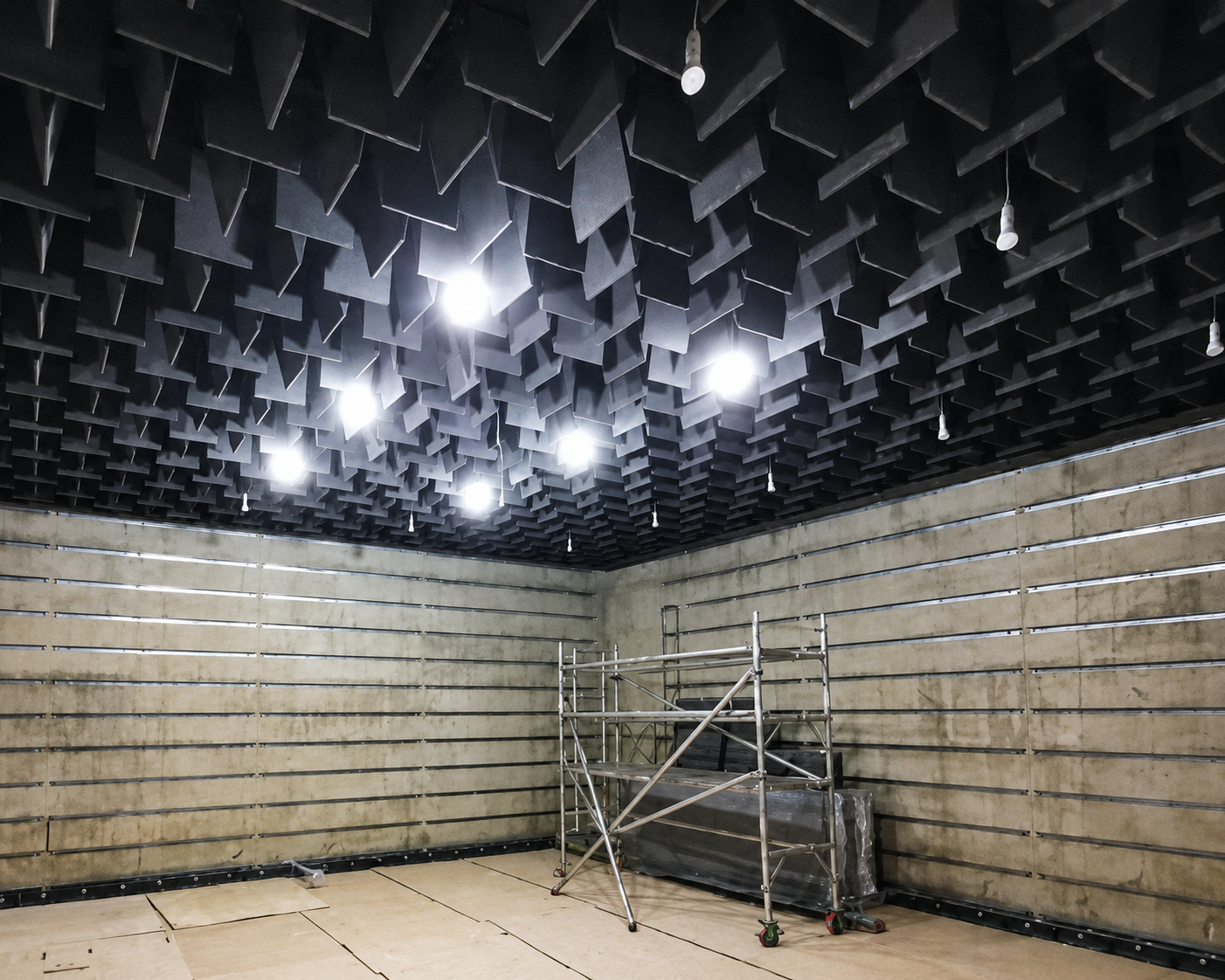
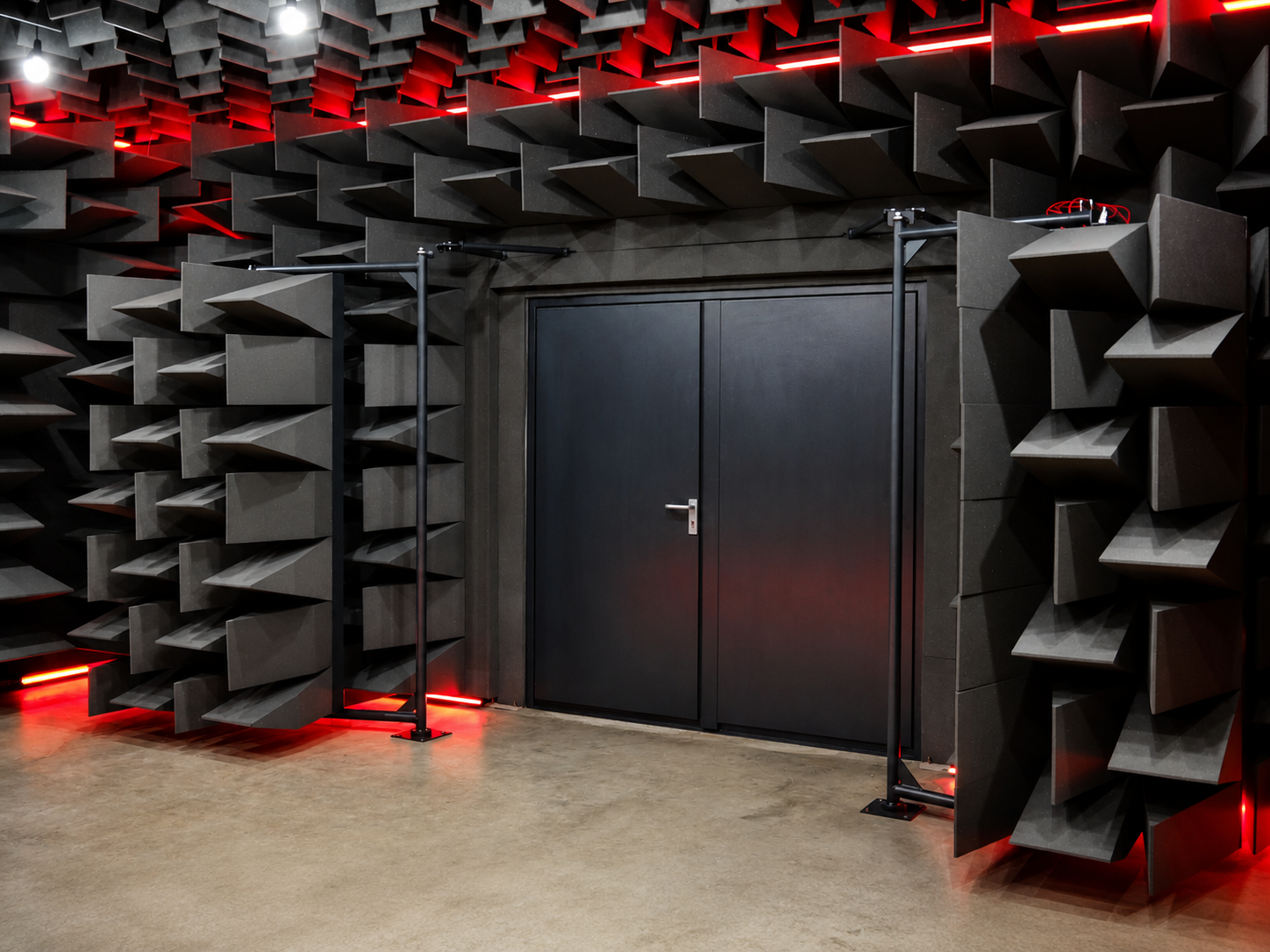
- Acoustic wedges lining the walls and ceiling to absorb sound rather than reflect it
- A room-in-room structure that isolates the chamber from the surrounding building
- Sealed acoustic doors and, where required, service penetrations designed to preserve acoustic integrity
- Careful control of ventilation, lighting, and electrical services to avoid introducing noise into the space
The critical difference and the reason the two types exist is what happens at floor level.
The Core Difference: Floor Treatment?
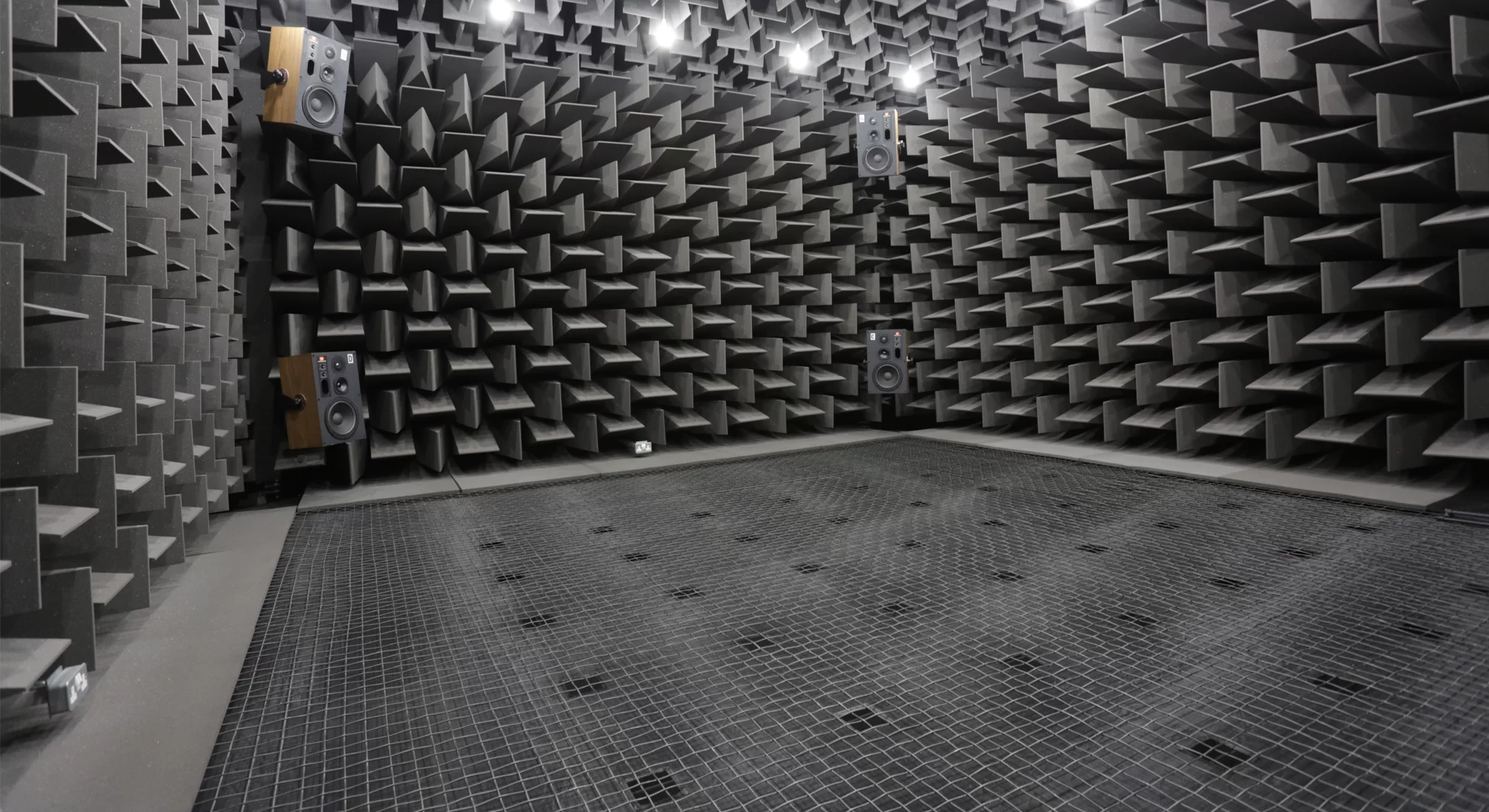
A full anechoic chamber treats all six surfaces of the room, including the floor, with acoustic wedges. Test subjects and equipment are typically supported on a suspended cable mesh floor or a lightweight walking grid above the wedges. Sound is absorbed in all directions, replicating the acoustic conditions of a free field: what you’d measure in the middle of a large open space with no reflective surfaces at all.
A semi-anechoic chamber treats five surfaces , walls and ceiling, with acoustic wedges, but has a solid, acoustically reflective floor. This replicates a hemi-free field: the acoustic conditions you’d measure outdoors on a hard surface, such as a car park or an airport apron.
That single difference – treated floor vs solid floor has significant consequences for what the chamber is used for, how it’s constructed, and how much it costs.
What Full Anechoic Chambers Are Used For
Full anechoic chambers are used where the acoustic measurement needs to be genuinely omnidirectional where sound reflections from a floor would corrupt the data.
Typical applications include:
- Acoustic research – investigating how sound behaves in idealised free-field conditions
- Loudspeaker and microphone testing – where the directional characteristics of the equipment need to be characterised without any surface reflections
- Precision noise measurement of small components – ultra-quiet electronics, medical devices, precision instruments
If the end user’s testing standard specifically requires free-field conditions, a full anechoic chamber is the only correct answer.
What Semi-Anechoic Chambers Are Used For
Semi-anechoic chambers replicate the acoustic conditions of an object sitting on a hard, reflective ground plane. This makes them the correct choice for testing products that would normally sit on the floor in real-world use.
Typical applications include:
- Automotive NVH testing – vehicles, engines, electric drivetrains, and their components
- Appliance and equipment testing – washing machines, HVAC units, fans, industrial motors
- Consumer electronics – larger devices tested against ISO 3744 or ISO 3746
- Defence and aerospace ground-based equipment – where equipment operates from a fixed platform
Because the majority of real-world products are used on a reflective surface (a floor, a road, a hardstanding), semi-anechoic chambers are more commonly specified than full anechoic chambers.
Implications for the Building
The choice between full and semi-anechoic has several practical consequences worth understanding:
Floor construction and load-bearing. A full anechoic chamber typically requires a substantial pit or void beneath the working level to accommodate the floor wedges. This affects sub-structure design, drainage, and access. A semi-anechoic chamber has a solid, load-bearing floor, which is significantly simpler to construct and can support heavier test subjects, including full vehicles and large industrial equipment.
Overall room dimensions. The wedges on all six surfaces of a full anechoic chamber consume internal volume. To achieve a given usable test space, the external building envelope needs to be larger than for an equivalent semi-anechoic chamber.
Access. Semi-anechoic chambers are easier to design for large test subjects, because the solid floor means test items can be rolled or driven in on wheels. Full anechoic chambers require the test subject to be supported above the floor wedges, which introduces access, safety, and handling complexity.
Cost. For all the reasons above, full anechoic chambers are generally more expensive to construct than semi-anechoic chambers of equivalent test volume. This is worth flagging early to the client.
What to Ask a Supplier
Whichever type of chamber is being built, the following are worth confirming with any supplier before commissioning:
- What background noise level (NR or dB(A)) will the chamber achieve?
- What cut-off frequency will the wedges deliver, and how does that align with the intended tests?
- What acoustic doors, service penetrations, and ventilation solutions are being proposed?
- How will the chamber be commissioned and verified against the relevant standard at handover?
- What documentation will be provided to support the end user’s own compliance obligations?
A specialist chamber supplier should be able to answer all of these clearly and provide reference projects to back up their claims.
Building an anechoic chamber? Speak to QuietStar.
QuietStar designs, manufactures, and installs full and semi-anechoic chambers across the UK and internationally with decades of experience delivering complex acoustic testing facilities for automotive, aerospace, defence, R&D, and academic clients.
View https://quietstar.co.uk/services/acoustic-testing-facilities/ or speak to our team on 0333 444 0458.
Related Services
Learn more about QuietStar’s audiology room design services and how we can support your next project.
Need help with a refurbishment? Explore our audiology room upgrades and acoustic treatment solutions.